|
|
|
Research Themes
Our research has three broad objectives:
|
| |
i) engineering of useful molecules
ii) methodology development
iii) structure-function relationship |
|
Project I: Streptavidin engineering
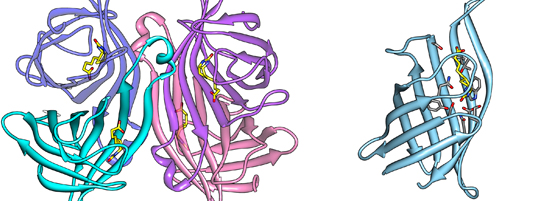
Streptavidin is one of the most widely used reagent in biotechnology and moelcular research, because the molecule binds the small molecule biotin with an affinity that is rarely matched by other systems. For example, the streptavidin-biotin pair is a convenient system for applications that require stable noncovalent interactions, including purification, immobilization, labeling, crosslinking, detection, just to name a few. In addition to the stable interaction, two additional factors contribute to the common use of streptavidin-biotin, including i) many chemical moieties can be easily biotinylated for detection by streptavidin, ii) streptavidin has high thermal and chemical stability, so that the molecule does not denature during application.
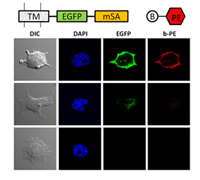
There is yet a notable limitation with the use of wt streptavidin, i.e. it can lead to target clustering because streptavidin has up to 4 functional high affinity biotin binding sites. The binding at two adjacent sites are anti-correlated and if the biotinylated ligand is large, streptavidin may bind only up to two ligand at a time. But this is sufficient to make the molecule unusable in some situations, including the labeling of biotinylated cell surface receptors. This topic has been addressed by other groups and resulted in a monovalent tetramer, comprised of wt and mutant chains. The mutant needs to be purified biochemical prior to use.
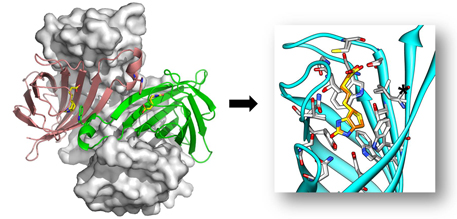
We are investigating a related problem from a different perspective, starting from the question, what structural properties allow the tetramer bind biotin with high affinity, whereas smaller subunits, such as monomer and dimer, cannot achieve a comparable affinity. Our study using engineered streptavidin molecules reveal that the model that is often cited, i.e. W120, is at best incomplete and at worst misleading. Rather, biochemical and molecular dynamics simulation studies show that there is significant cooperative between various subunit interactions, and disrupted subunit interactions may underlie the fundamental difference between wt tetramer and the constituent monomer and dimer subunits. Our goal is to construct and characterize various streptavidin oligomers in order to develop a more accurate model of the structure-function relationship for streptavidin and to engineer novel streptavidin mutants for biotechnology applications.
See Hsu & Park (2010), Hsu et al (in preparation)
|
Project II: Disulfide crosslinking on the yeast surface ("STUCKED")
Two major strategies of protein engineering are rational design and directed evolution. Yeast surface is a powerful platform for directed evolution. There are several alternative platforms for directed evolution, most commonly including phage display, bacterial display, yeast display, ribosomal display, mRNA display. Each has its advantages and limitations. For example, yeast display is useful and an attractive choice, if the proper folding of the engineered protein requires posttranslational processing that is available in a eukaryotic organisms. For example, many extracellular proteins contain a disulfide bond, and the oxidation of cysteine side chain to form a disulfide bond is a form of posttranslational modification that is available within yeast but is less developed in prokaryotic cells, such as E. coli--although this issue is being addressed by separately expressing protein disulfide isomerase. The protein libraries expressed on the yeast surface can be analyzed by flow cytometry, which yields quantitative data in a high throughput manner.
We are interested in developing a way to screen protein interaction using yeast display that does not require separate purification. To see how our approach is different from the way protein interaction is typically engineered in yeast, imagine the screening of a single chain antibody (scFv) library on the yeast surface. In order to find the high affinity mutant for a target molecule, e.g. protein X, the scFv library is first displayed and labeled with protein X that is fluorescently conjugated either covalently or noncovalently through streptavidin-biotin linkage or antibody. This requires purification and, possibly, modification of protein X prior to the assay. Instead, we co-express the two potentially interacting molecules in the same yeast cell either for surface anchoring by fusing with Aga2 or for secretion. If the two molecules interact during the transit to the surface, they form a complex that can be detected on the surface. In order to extend the technology to complexes that are too unstable to be efficiently detected, we introduce a structure based disulfide bond between the chains. The formation of the disulfide correlates with the protein interaction, and the secreted subunit that becomes "STUCKED" on the surface are the ones that specifically interacted with the anchored subunit.
We have applied it to several independent systems and shown that the technique is general. One of the advantages of our system compared to the traditional yeast display is that the screen yield structural information regarding the complex, if at low resolution, because the disulfide formation is highly sensitive to the local conformation and solvent-exposed cysteine residues that are not near each other in the bound complex do not form a disulfide to a significant degree. We are testing the combination of disulfide trapping and competition assay to engineer novel protein inhibitors of important biological targets.
See Lim et al Biotech Bioeng (2010)
|
 |
 |
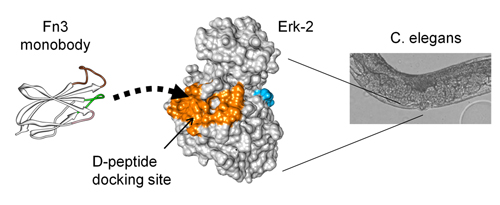
Project III: Determinants of substrate specificity during posttranslational modification (PTM)
The majority of the proteins synthesized in the cell are posttranslationally modified at various points in their life cycle. Some modifications are required for folding and stability (e.g. disulfide formation, proteolytic cleavage, N-glycosylation) and some are used to signal degredation (e.g. ubiquitination). By far the most common forms of modification are, however, used to change the functional state of the molecule. For example, phosphorylation is an event by which the side chain of Ser, Thr, and Tyr are modified by addition of a phosphate group. The modification changes the chemical and structural property of the side chain, and along with it, both structural and functional characteristics of the protein molecule as a whole. Similarly, acetylation, methylation, carboxylation, etc are used to alter the structural/functional state of a molecule. These and other modifications, most of which can be enzymatically reversed, are thus important to determine the function of individual protein molecules and by extension the interaction of the proteome as a whole.
One of the challenges in the current proteomic research is the mapping of the PTM modification sites. This poses a technological challenge due to a number of factors: i) the large number of potential sites that may be modified, ii) the dynamic, i.e. transient, state of the modification, iii) the low abundance of many proteins in the cell. Because the interaction among protein molecules can change following PTM modifications, it is of fundamental importance to identify the sites of modification in vivo as well as the enzymes responsible for such modifications.
 |
We are investigating the use of a FRET reporter to map the interactions between a PTM enzyme and a potential substrate peptide. We use flow cytometry in the assay because it is an inherently high throughput screening method, capable of inspecting > 10,000 different variants per second. The FRET detector that undergoes a PTM-dependent conformational change, resulting in an increase in FRET that can be detected on a flow cytometer. By substituting different enzymes and peptide substrates, we hope to accelerate the rate of discovery toward characterizing the enzyme-substrate relationship.
See Lim et al Biotechnol Progress (2010). |
|
Project IV: G-protein coupled receptor (GPCR)
Cells communite with the outside world using cell surface receptors, many of which are G-protein coupled receptors (GPCR). GPCRs bind a large range of ligands, including small molecules, peptides, and hormones, and initiate cell signaling that ultimately result in cellular responses. Because they constitute one of the largest family of signaling molecules, they are the molecular targets of many pharmacologic drugs. For example, H1 antagonists, such as claritin, zirtec, and allegra, are drugs that target the histamine receptor H1 for treating allergy. The GPCR proteins are only second to the enzymes as therapeutic targets. We are developing an assay to find novel agonists/antagonists for other GPCR proteins using yeast as the engineering platform. Yeast has a number of advantages over mammalian expression systems, including fast growth, cheaper media, and ease of screening. It has been demonstrated in a large of studies that yeast can express functional human GPCR on its membrane. While this does not guarantee that all human GPCR proteins would be functional, it does raise a hope that a useful functional GPCR assay can be developed in yeast to accelerate the drug discovery process.
| There are two technical challenges. First, human GPCR proteins do not couple very efficiently to the yeast signaling pathway, making it difficult to develop a yeast based GPCR screen. This was addressed in the past by creating chimeric Galpha subunits from human and yeast subunits to facilitate the signaling. Theoretically, it should be possible to couple other GPCR's to the yeast signaling pathway and develop a functional screen. Second, the existing yeast based screens target only GPCR's whose ligands are small enough to penetrate the cell wall. The cell wall creates a physical barrier that excludes large ligands from the periplasmic space where GPCR is expressed. There are various ways to overcome the obstacle. We are testing a novel screening method that does not require enzymatic treatment of the cell to hydrolyze the cell wall, which can compromise the cell viability, lead to receptor degradation, and makes it nearly difficult to automate the drug screening. |
 |
|
We have additional computational projects for those who are more computationally inclined. |
We use the following techniques in our study:
-Yeast surface display
-Fluorescence resonance energy transfer (FRET)
-Directed evolution
-Computer modeling and MD simulations
-Bioinformatics |
|