

Please watch this video to get started.
Hello, hello all you lovely people!
I’m Professor David Emmanuel Gray and I’ll be your guide this semester through the wonderful world of ethics. With an open mind and a bit of work, you will learn a lot about the study of ethics, its practical applications, and maybe even a little bit about yourself and your place within the world.
Please take a few minutes to watch my video (above), and I’ll introduce myself and the course. You can then start to explore this page (and then this entire website) to get better oriented.
Feel free to bookmark this site while you are here. You might even add a link to your phone’s home screen for easy access.
For now, though, I look forward to seeing you online!
David
(I’m a bit old fashioned, so I’d prefer you call me “Professor Gray”. If you do call me “David”, though, I won’t freak out or anything. Call me “Dave” or “Davy”, and I’ll think you are my wife, which would be extremely awkward.)
Bring on the heat and pressure! That’s how diamonds are made.
🪨🔥💎
Photo: Justin Lubin / NBC.
How This Course Works
- This is a fully online course for the Spring 2026 semester.
- There is no required textbook. All readings are available in the course modules on this website.
- This class does not meet regularly in Zoom. Course material will be presented asynchronously (“recorded not real time”) on this website and on UB Learns.
- This class is organized by having you complete 2 modules each week. This is not a self-paced course.
- Each module contains learning outcomes, readings (posted on Perusall), some background context and reading questions, videos, and quizzes.
- Modules are spread out across 6 units, and each unit ends with a unit exam.
- As you complete course activities, you will earn philosophy experience points and philosopher’s stones. In particular, you earn these from completing the quizzes in (a) the lecture video quizzes (posted on Panopto) and (b) the end-of-module quizzes (posted on UB Learns) and from completing the unit exams. There are also five optional, supplementary modules for earning bonus points.
- Commenting on the readings and/or answering the reading questions (in Perusall) does not earn points—though doing so may help you do better on the quizzes and exams.
- Finally, if you are starting to feel overwhelmed, do not panic! The grading scheme is flexible for how you earn philosophy experience points, while you can use philosopher’s stones for extensions or to make up for missed work. Philosopher’s stones can be real lifesavers when you are struggling balancing everything.

Photo: Colleen Hayes / NBC.
My Teaching Philosophy
I believe that learning is a form of liberation. It sets you on the path towards greater independence, self-mastery, and success in life. When done with others (as is often the case), it also strengthens our relationships, creating communities of mutual respect and trust. I am truly humbled to serve you in that journey. For this particular course, I will work with you to cultivate your abilities for critical reflection and practical deliberation about moral issues. I do all this with a spirit of generosity, hoping that you too will freely share your gifts to better the lives of those around you.

Photo: Colleen Hayes / NBC.
Our Pact
What you can expect from me:
- I will treat you with dignity and respect and be flexible to support your individual needs.
- I will provide you with a clear, organized course that is designed to ensure you meet our learning outcomes in a meaningful manner.
- I will be actively present in your learning.
- I will provide a supportive and safe environment for you to share and discuss ideas.
- I will reach out to you when I sense that you need support.
- I won’t be perfect. I am human and will make mistakes at times. I will view mistakes as an opportunity to learn and grow.
What I will expect from you:
- You will treat me and your peers with dignity and respect.
- You will strive to be actively engaged in this course and aim to meet due dates.
- You will maintain an open line of communication with me so I understand how to support you.
- You will contact me if you have a concern with meeting a due date.
- You will give yourself grace. Expect to make mistakes. You are human and mistakes are part of learning and growing.
(This pact comes from Michelle Pacansky-Brock. Generally speaking, this whole welcome page draws on many of her insights—she’s an inspiration!)

Photo: Colleen Hayes / NBC.
Week 1 Success Kit
Online courses move quickly, and getting off to a good start is the best way to prepare yourself for success. Read this page carefully and you’ll have all you need to start this course on the right foot!
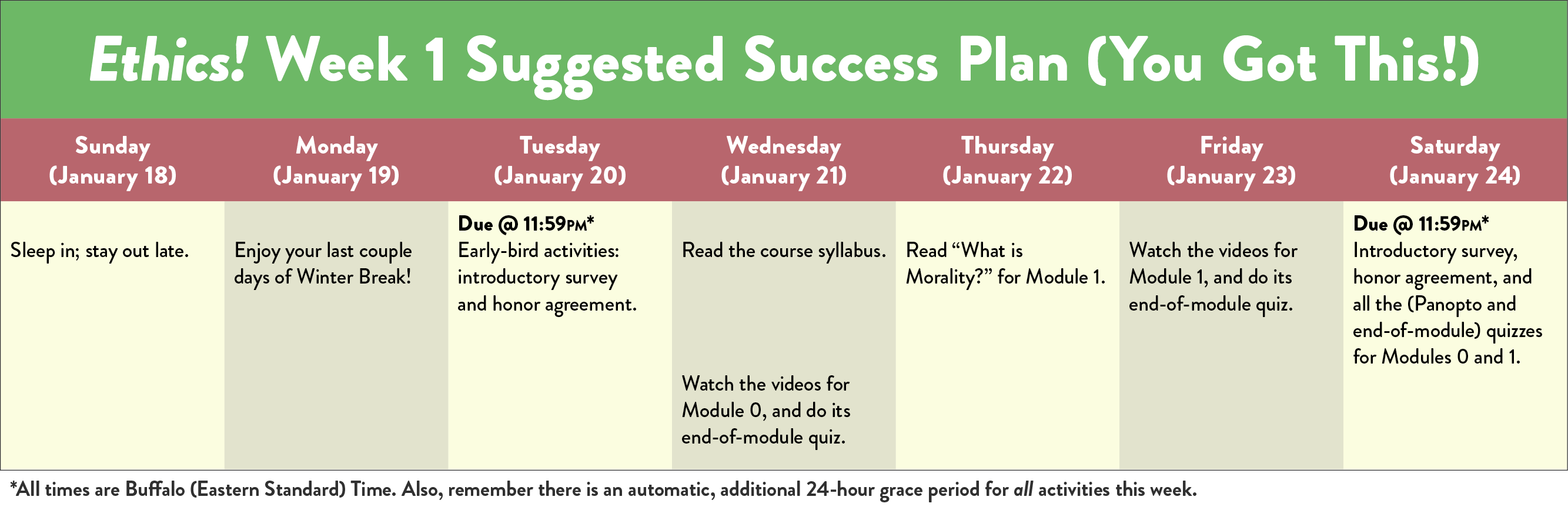
Due Dates for Week 1
Tuesday, January 20 at 11:59PM (midnight), Buffalo (Eastern Standard) Time
(Keep in mind that everything here qualifies for the 24-hour grace period for completion.)
-
Complete these early-bird activities and you’ll earn some bonus philosopher’s stones:
1. Fill out the introductory survey that is posted on Google Forms. You will earn 1 philosopher’s stone for completing this survey. 2. Read the Academic Honor Code for the course and “sign” the honor agreement posted on UB Learns. You will earn 1 philosopher’s stone for completing this agreement.
Saturday, January 24 at 11:59PM (midnight), Buffalo (Eastern Standard) Time
(Keep in mind that everything here qualifies for the 24-hour grace period for completion.)
- Fill out the introductory survey (if you haven’t already). This is not graded. However, once the grace period ends, you will lose 10 philosophy experience points per day until it is done.
- Sign the honor agreement (if you haven’t already). Make sure you have read the Academic Honor Code for the course first. This is not graded. However, you will not earn any philosophy experience points in this course until you have signed this agreement.
- Read the material for Module 0 and Module 1. While there are no reading questions for Module 0, you will find reading questions for all the other modules posted on (1) Perusall and (2) each module’s webpage after the “Context” section. You are not required to leave any comments on the readings—but please feel free to do so! These are not graded. However, doing the readings will help with the lecture videos as well as with the reading-related problems on the end-of-module quizzes and the unit exams.
- Complete the Panopto video quizzes for Module 0 and Module 1. (Remember, you can always rewind the videos to find the answers.)
- Complete the end-of-module quizzes for Module 0 and Module 1. Remember, you will find a link to these end-of-module quizzes on each module’s page in the “Do This” section, which comes right after the “Watch This” section with the videos.
Success Tip!
Start organizing your notes in preparation for the Unit 1 Exam on Monday, September 8.