Pavan Varma Pothuri

PhD Student in Robotics, University at Buffalo

I research autonomy for aerial robots in the DRONES Lab, with a focus on multimodal perception, active mapping, and energy-aware planning, validated through flight experiments on real multirotors. My first-author work on vision-based UAV tracking received the Best Student Paper award at AIAA AVIATION 2025.

Attending IROS 2026, Pittsburgh, September 27 to October 1

I am seeking research internship opportunities in aerial autonomy, robot perception, and robot learning, and would welcome the chance to connect during the conference.

Save contact Résumé (PDF) Email
QR code that opens this website
Website
QR code that opens my résumé
Résumé
QR code that opens this website

Pavan Varma Pothuri

buffalo.edu/~jagadesw

About

Pavan Varma Pothuri by a lake
PhD CSE · Robotics
University at Buffalo

Jagadeswara Pavan Kumar Varma Pothuri

I am a PhD student in Computer Science and Engineering at the University at Buffalo, working in the DRONES Lab under the supervision of Dr. Karthik Dantu. My research develops perception and planning methods for aerial robots.

My approach begins with understanding the underlying concepts and working through the mathematics: formulating the problem, modeling the dynamics, and analyzing the method. I then implement and test it in simulation, and finally validate it on real hardware through flight experiments.

My current work centers on multimodal active mapping, in which a UAV equipped with thermal, hyperspectral, and LiDAR sensors plans where to measure under limited flight endurance. I previously completed an M.S. in Robotics at the University at Buffalo in the ADAMS Lab, advised by Dr. Souma Chowdhury, and worked for two years as a software developer at Tata Consultancy Services.

Best Student Paper, AIAA Intelligent Systems Student Paper Competition, AIAA AVIATION 2025 (first author). AIAA announcement ↗

Research Interests

  1. Multimodal Perception for Aerial Robots

    RGB, thermal, hyperspectral, and LiDAR each capture a different part of a scene. I’m interested in fusing them onboard a UAV, within the weight, power, and compute budget of a small airframe, so the robot can act on information no single sensor provides.

  2. Energy-Aware Path Planning for Multirotors

    Battery life is the hard limit on what a multirotor can do. I’m working toward planners that model power draw directly (hover, climb, speed, wind) and decide where to fly and what to measure within a single charge.

  3. World Models

    Learned dynamics models that let a UAV roll out likely futures and plan over a horizon, aiming for sample-efficient control that transfers to hardware.

  4. Physics-Informed Learning

    Using quadrotor dynamics as structure inside learned models (including PINNs), so policies need less data and stay physically consistent.

  5. Generative Policies: Diffusion and VLA

    Diffusion policies and vision-language-action models as a route to more general control, and what it takes to make them reliable enough to run on a real drone.

Publications

  1. 2026

    Efficient Planning for Scalable and Load-Balanced Area Coverage by Multiple Unmanned Aerial Vehicles

    P. KrisshnaKumar, J. Witter, L. Collins, J. P. K. V. Pothuri, P. Ghassemi, E. T. Esfahani, K. Dantu, S. Chowdhury

    Journal of Computing and Information Science in Engineering (ASME), vol. 26, no. 9 · 2026

    A fast planner that divides a survey area among many UAVs, balances each vehicle’s workload, and handles irregular regions with no-fly zones. Validated from a 3-UAV field flight up to 150-UAV simulations, for time-critical jobs like post-flood mapping.

    BibTeX
    @article{krisshnakumar2026coverage,
      title   = {Efficient Planning for Scalable and Load-Balanced Area Coverage by Multiple Unmanned Aerial Vehicles},
      author  = {KrisshnaKumar, Prajit and Witter, Jhoel and Collins, Leighton and Pothuri, Jagadeswara P. K. V. and Ghassemi, Payam and Esfahani, Ehsan T. and Dantu, Karthik and Chowdhury, Souma},
      journal = {Journal of Computing and Information Science in Engineering},
      volume  = {26},
      number  = {9},
      year    = {2026},
      publisher = {ASME},
      doi     = {10.1115/1.4071466}
    }
  2. 2025

    Learning Approach to Efficient Vision-Based Active Tracking of a Flying Target by an Unmanned Aerial Vehicle

    J. P. K. V. Pothuri, A. Bhatt, P. KrisshnaKumar, M. Oddiraju, S. Chowdhury

    AIAA AVIATION Forum 2025

    Best Student Paper · AIAA Intelligent Systems Student Paper Competition

    One UAV follows another in real time using only a camera. A detector and a lightweight visual tracker estimate the target’s position, and an RL velocity controller trained in AirSim decides how to move within the UAV’s limits. It beat a tuned PID baseline and transferred to a real Crazyflie with no GPS.

    BibTeX
    @inproceedings{pothuri2025tracking,
      title     = {Learning Approach to Efficient Vision-Based Active Tracking of a Flying Target by an Unmanned Aerial Vehicle},
      author    = {Pothuri, Jagadeswara P. K. V. and Bhatt, Aditya and KrisshnaKumar, Prajit and Oddiraju, Manaswin and Chowdhury, Souma},
      booktitle = {AIAA AVIATION Forum and ASCEND 2025},
      publisher = {American Institute of Aeronautics and Astronautics},
      year      = {2025},
      doi       = {10.2514/6.2025-3549}
    }
  3. 2024

    An Open-Source Hardware/Software Architecture and Supporting Simulation Environment to Perform Human FPV Flight Demonstrations for Unmanned Aerial Vehicle Autonomy

    H. Xiao, P. KrisshnaKumar, J. P. K. V. Pothuri, P. Soni, E. Butcher, S. Chowdhury

    AIAA AVIATION Forum 2024

    A low-cost, open platform for recording how people fly UAVs in first-person view. It logs synchronized video and flight data and exposes full control through a Python interface. A matching AirSim / Unreal Engine digital twin supports hardware-in-the-loop testing, so demonstrations collected on either side can train autonomous agents.

    Simulation and real-world flights

    SimulationTakeoff · Hover · Land
    SimulationPoint-to-Point (A→B)
    SimulationObstacle Avoidance
    Real-worldTakeoff · Hover · Land
    Real-worldPoint-to-Point (A→B)
    Real-worldObstacle Avoidance

    Pilots fly the same three tasks on a real F450 / Pixhawk quadcopter and in the AirSim / Unreal Engine twin: takeoff, hover, and land; point-to-point navigation over obstacles; and an obstacle-avoidance course. The Pixhawk runs hardware-in-the-loop with the simulator.

    BibTeX
    @inproceedings{xiao2024fpv,
      title     = {An Open-Source Hardware/Software Architecture and Supporting Simulation Environment to Perform Human FPV Flight Demonstrations for Unmanned Aerial Vehicle Autonomy},
      author    = {Xiao, Haosong and KrisshnaKumar, Prajit and Pothuri, Jagadeswara P. K. V. and Soni, Puru and Butcher, Eric and Chowdhury, Souma},
      booktitle = {AIAA AVIATION Forum and ASCEND 2024},
      publisher = {American Institute of Aeronautics and Astronautics},
      year      = {2024},
      doi       = {10.2514/6.2024-4458}
    }

My master’s thesis (2025)

Algorithms and Physical Experiments for Vision-Based Tracking and Operations of Unmanned Aerial Vehicles

M.S. in Robotics, University at Buffalo, advised by Dr. Souma Chowdhury in the ADAMS Lab

Vision-based tracking and operation of UAVs using only onboard cameras, taken from algorithm to flight test. The core question: can one quadrotor follow another flying UAV using vision alone? The pipeline pairs an efficient detector with an RL velocity controller trained in AirSim under the drone’s real motion limits. It kept the target in frame longer and held stand-off distance more steadily than a tuned PID baseline, and it ran on a real Crazyflie without GPS.

Read the thesis on ProQuest →
Current Project

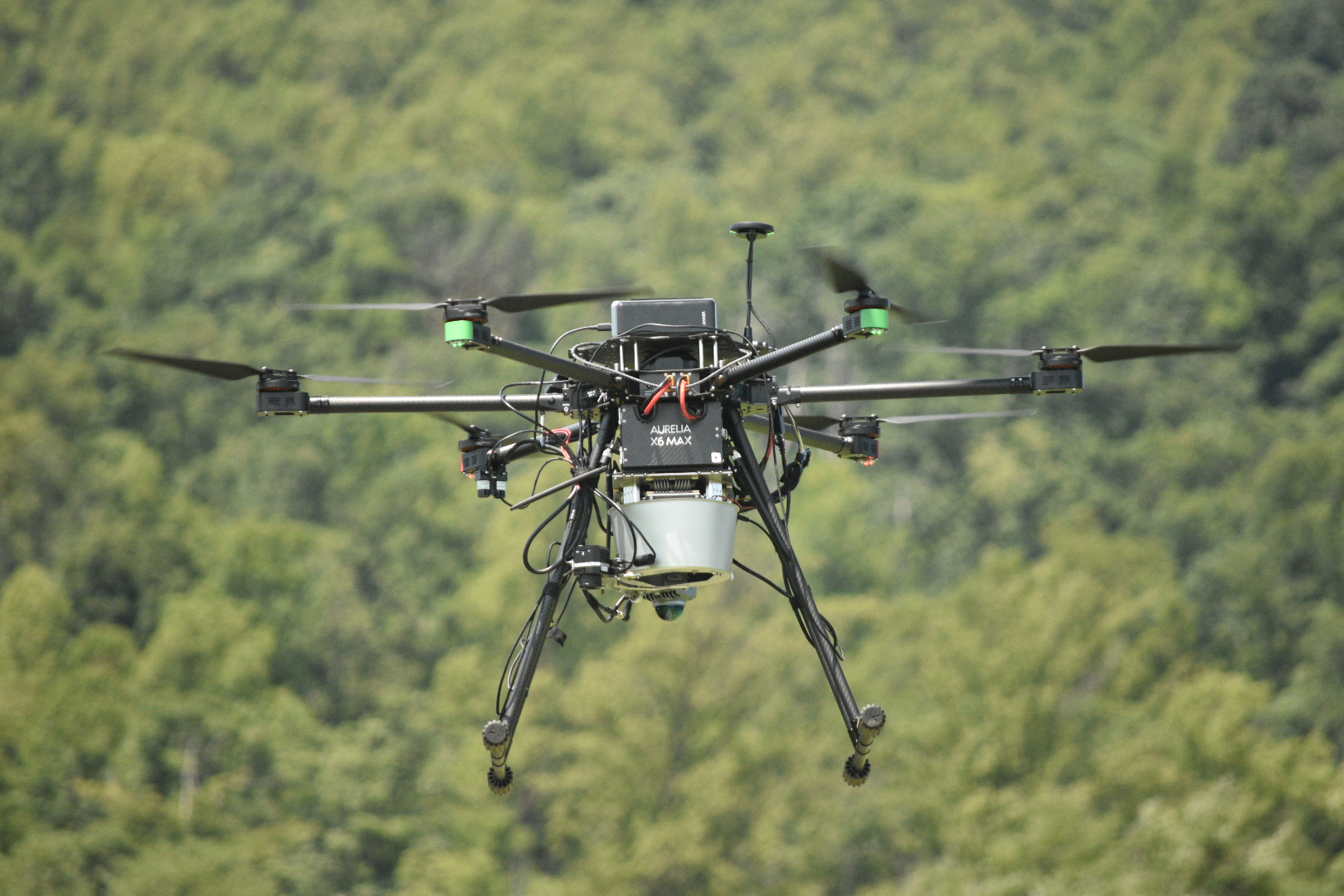
VISTA hexarotor flying over a field with thermal, hyperspectral, and LiDAR sensors

VISTA: Vegetation Informed Sensing Through Active Mapping

With Charuvahan Adhivarahan and Dr. Karthik Dantu

How should a small UAV spend limited flight time over a field? In VISTA, satellite priors guide an adaptive planner, and onboard hyperspectral observations update where the aircraft measures next.

  • Targets patchy vegetation change instead of flying exhaustive uniform coverage.
  • Closes the loop between active planning, ROS-based flight execution, and field measurements.
  • Pairs hyperspectral sensing with thermal and LiDAR data in outdoor field studies.
Explore VISTA

Experience

2025 – now

PhD, Computer Science & Engineering (Robotics)

University at Buffalo, DRONES Lab, advised by Dr. Karthik Dantu

Research on perception, planning, and learning-based autonomy for UAVs, including the VISTA active-mapping project.

2023 – 2025

M.S. in Robotics, GPA 4.0

University at Buffalo, ADAMS Lab, advised by Dr. Souma Chowdhury

Research assistant. Built and flew autonomous UAVs (PX4, ArduPilot, Jetson), ran field tests, and mentored students in ROS 2 and MAVROS. Teaching assistant for MAE 550, Optimization in Engineering Design.

2020 – 2022

Software Developer

Tata Consultancy Services, Hyderabad

Built a real-time recommendation engine that made IT support 35% faster, and a dashboard that forecast ticket volume across 500+ applications with 92%+ accuracy. Three-time “Best Employee of the Month.”

2016 – 2020

B.Tech in Electronics & Communication Engineering

JNTU Kakinada. GPA 9.05 / 10.

Technical Skills

Languages

  • Python
  • C++
  • CUDA
  • MATLAB
  • Bash

Robotics & Autonomy

  • ROS 2
  • PX4 / ArduPilot
  • MAVROS / MAVLink
  • SLAM
  • Sensor Fusion
  • Motion Planning
  • MPC
  • PID
  • Nav2

Machine Learning & Vision

  • PyTorch
  • OpenCV
  • Reinforcement Learning
  • Imitation Learning
  • Object Detection
  • Visual-Inertial Odometry
  • Transformers / VLMs
  • Stable-Baselines3

Simulation & Digital Twins

  • Isaac Sim / Lab
  • AirSim
  • Gazebo
  • MuJoCo
  • PyBullet
  • Unreal Engine
  • Hardware-in-the-Loop

Hardware & Sensors

  • NVIDIA Jetson
  • Pixhawk
  • Crazyflie
  • Intel RealSense
  • LiDAR
  • Thermal & Hyperspectral
  • IMU / GPS-RTK
  • FPV Systems

Infrastructure

  • Docker
  • Git
  • CI/CD
  • Linux
  • Conda
  • Weights & Biases
  • TensorRT / ONNX
  • SLURM / HPC

Contact

I am seeking research internships in aerial autonomy, robot perception, and robot learning. Please reach out by email.

Side project: Neuronauts, an introductory resource on artificial intelligence.