

Laboratory for the Study of Ingestive Behavior
Daniels Lab - Research Projects

Determining the behavioral relevance of angiotensin intracellular signaling pathways
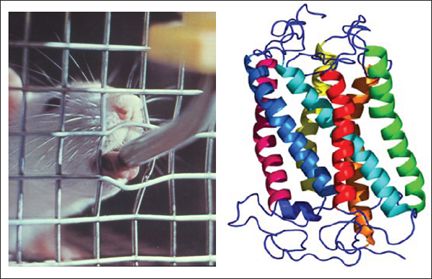
Regulating proper body fluid balance is critical for life. A number of physiological mechanisms help prevent the loss of additional fluid during dehydration, but in order to restore fluid levels to normal, an animal must drink. Angiotensin II is a key hormone in the control of drinking behavior. Our laboratory is trying to understand what events occur after angiotensin II acts on its receptors in the brain and how these events lead to increased or decreased responses to angiotensin II.
Understanding the interaction between feeding- and drinking-related systems
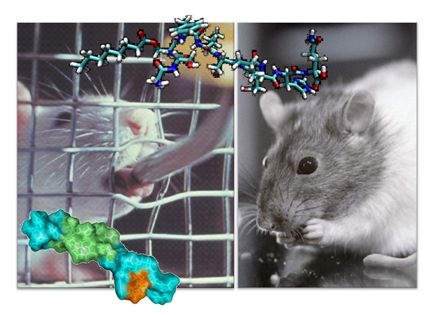
Recent advances in science and the worldwide rise of obesity have fueled a remarkable surge in the study of feeding behavior. These studies have revealed a large number of peptides that influence feeding behavior, but far less attention has been paid to the role these peptides may play in drinking behavior. Our laboratory performs experiments that test the effect of several "feeding-related" peptides on water and salt intake.
Determining the site(s) upon which peptides act within the brain to initiate widespread neural changes that influence behavior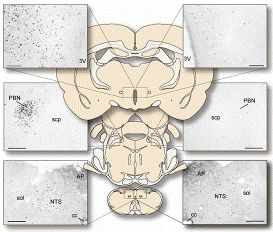
Modern concepts of the regulation of food intake favor distributed neural circuits over earlier ideas of feeding and satiety "centers" in the brain. Research in this laboratory embraces this modern idea of distributed networks and investigates the hypothesis that at least some of these networks contain multiple initiation sites, each of which is capable of responding to a given peptide and subsequently recruiting activation of the rest of the circuit. Examination of the neural circuit that responds to the peptide urocortin I supports this hypothesis. Injections of urocortin I into a variety of brain areas elicits a similar pattern of neural activity throughout the brain. Studies using chronically maintained decerebrate rats indicate that ascending and descending pathways are required for some of the neural activation observed in the hypothalamus and caudal brainstem after urocortin I was injected into the fourth ventricle. Ongoing projects in the laboratory are designed to extend this concept to other peptide systems and further delineate the circuit through which the hypothesized recruitment of other brain structures occurs.
Angiotensin receptor signaling pathways and water/salt intake
Finding drinking responses from "feeding-related" peptides
Understanding peptide-responsive neural circuits
Laboratory for the Study of Ingestive Behavior
Department of Psychology, University at Buffalo
phone: (716) 645-0272

Last update: September 2014








